Table Of Content
Its psychological insight and philosophical meaning are all too relevant for this song to be anything but timeless. But it’s hard to imagine that anybody will ever again inhabit that doomed soul at the epicenter of the tale quite as well. In 2014, Five Finger Death Punch released a cover version for their album The Wrong Side of Heaven and the Righteous Side of Hell, Volume 2.
Origin and early versions
The musicologist Alan Lomax couldn’t even pinpoint the song’s exact origin, although he found evidence that jazz musicians knew of it even before World War I. Early versions of the song had promoted the meaning that the Rising Sun was a brothel. In these variations, the narrator is a woman bemoaning her return to prostitution. Male singers made it “the ruin of many a poor boy,” which transformed the title establishment into a gambling den. In August 1980, Dolly Parton released a cover of the song as the third single from her album 9 to 5 and Odd Jobs. Like Miller's earlier country hit, Parton's remake returns the song to its original lyric of being about a fallen woman.
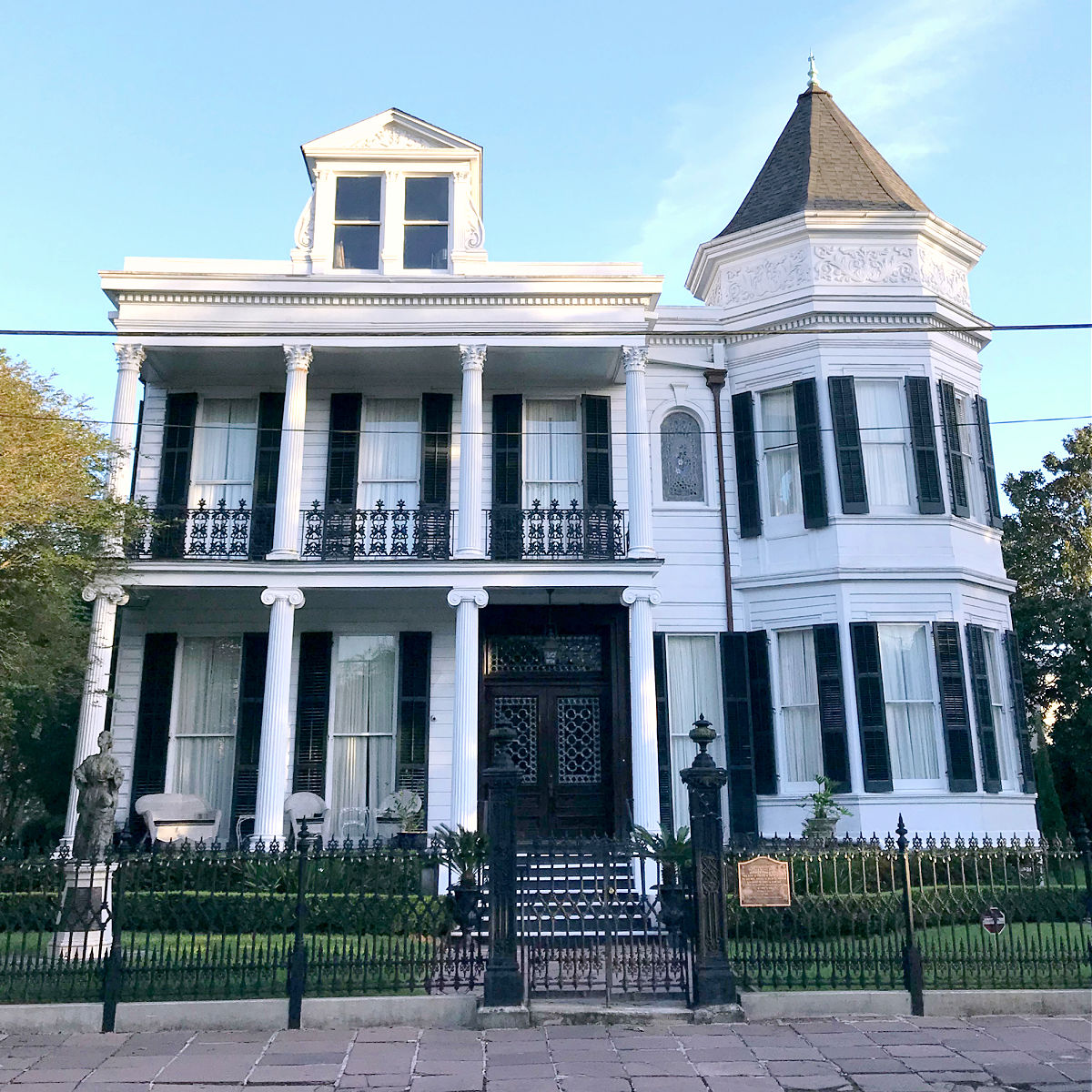
AMC 'Mayfair Witches' house in New Orleans looks a lot like Anne Rice's old First Street home - NOLA.com
AMC 'Mayfair Witches' house in New Orleans looks a lot like Anne Rice's old First Street home.
Posted: Thu, 12 Jan 2023 08:00:00 GMT [source]
Frijid Pink version
Five Finger Death Punch's remake reached number 7 on the US Billboard Mainstream Rock chart. The single also charted in Australia (number 14), France (number 36), and Italy (number 54). The song was first collected in Appalachia in the 1930s, but probably has its roots in traditional English folk song. A detail shot of the inside of the main entrance to the old Olivier plantation house, including its fan-shaped transom. "House of the Rising Sun" is a modern American myth and a true folk song because it is still evolving today. Only the lyrics and melodies that shake the bottom of the soul linger in the mind long enough to be passed along to the next singer, and "The House of the Rising Sun" was a particularly memorable song.
More Songfacts:
Historic cornstalk fence house in New Orleans, owned by Paul McCartney's manager, gets a makeover - NOLA.com
Historic cornstalk fence house in New Orleans, owned by Paul McCartney's manager, gets a makeover.
Posted: Tue, 03 Aug 2021 07:00:00 GMT [source]
The Parton version makes it quite blunt, with a few new lyric lines that were written by Parton. Parton's remake reached number 14 on the US country singles chart and crossed over to the pop charts, where it reached number 77 on the Billboard Hot 100; it also reached number 30 on the US Adult Contemporary chart. Parton has occasionally performed the song live, including on her 1987–88 television show, in an episode taped in New Orleans. The Animals' version of the American folk song is considered one of the 20th century’s British pop classics. While the original version was sung in the character of a woman led into a life of degradation, the Animals' version is told from the view of a young man who follows his father into alcoholism and gambling ruin.

The song is also credited to Ronnie Gilbert on an album by the Weavers released in the late 1940s or early 1950s. Pete Seeger released a version on Folkways Records in 1958, which was re-released by Smithsonian Folkways in 2009.[16] Andy Griffith recorded the song on his 1959 album Andy Griffith Shouts the Blues and Old Timey Songs. Although the lead singer had never been to Appalachia, he was a poor boy from London who had spent time at Paris brothels.

The song is often heard in the soundtracks of popular TV shows (The West Wing and Supernatural) and movies (Suicide Squad). By the time the ’60s rolled around, the folk legend Dave Van Ronk included an intense take on “House of the Rising Sun” as a steady part of his live repertoire. His young acolyte Bob Dylan largely mimicked Van Ronk’s arrangement of the song and included it on his debut album.
Joining them were the city’s first three Marianite nuns, a separate order but part of the same Congregation of the Holy Cross religious family. They, too, would later go on to found local schools, including Holy Angels Academy in the Bywater and Our Lady of Holy Cross College (now University of Holy Cross) in Algiers. The songs would evolve as they moved around the land like a giant game of Chinese telephone. It’s a song about addiction, pleasure, and how those forces took someone the singer loves–and how badly they want to warn others not to go there.
And maybe he even hesitates for just a moment before committing to his return, Well, I got one foot on the platform/The other on the train. The man who ran Nirvana's first label gets beyond the sensationalism (drugs, Courtney) to discuss their musical and cultural triumphs in the years before Nevermind. Lang deals with principles of Buddhism, including the cycles of birth and death. The 1979 song "Life During Wartime" by Talking Heads deals with how technology could be exploited to take down the framework of society and enable government surveillance. At the time, New Orleans businesses listed as coffee houses often also sold alcoholic beverages.
Behind the Meaning of Elle King’s Irreverent “Baby Daddy’s Weekend”
Her bluesy voice gives real soul to the song, which remains imprinted on the song today through many remakes. In Guthrie’s version (considered closer to the original folk song than the far more famous cover by the Animals), the singer of the song is a woman who has been led astray by a drunkard gambler despite her working-class mother’s honest example. “(The) House of the Rising Sun” (also known as “Rising Sun Blues”) is a traditional folk song which tells of a life gone wrong in New Orleans, Louisiana. By then, the two-story Creole-style plantation house overlooking the Mississippi River from its perch at Chartres and Mazant streets was far past its prime, having crumbled into ruin after years of neglect. Long before radio, people passed folk songs around in the Appalachia hills by word of mouth.
Famous Yugoslav singer Miodrag "Miki" Jevremović covered the song and included it in his 1964 EP "18 Žutih Ruža" (eng. "Eighteen Yellow Roses"). In 1871, the Marianites took over sole control of the orphanage, a duty they would hold for 61 years. In that time, it would grow to include additional buildings, including a Gothic chapel erected in 1891 to replace a wood chapel near the corner of Chartres and Mazant.
It has been performed by many artists, including Joan Baez, Nina Simone, Bob Dylan, and The Animals. The tragedy of “House of the Rising Sun” is that the narrator seems to have lost his free will. He knows that the house will be his damnation, yet he is en route while he is telling his sad story. At the very least, he tries to use his example to save others—Oh mother, tell you children not to do what I have done.
There is a house in New Orleans / They call the Rising Sun / And it’s been the ruin of many a poor boy / And God, I know I’m one, they sing in the chorus. A song is written, and, if it’s special enough, it hangs around waiting for an artist to claim it, putting their indelible stamp on it so that all other versions are henceforth compared to that one unforgettable take. Nobody is sure who wrote “House of the Rising Sun.” But we do know that the Animals, powered by the blustery vocals of Eric Burdon, claimed it. Many have sung “House of the Rising Sun” before Eric Burdon took it on with the Animals, and many will sing it in the future.
A beautiful, comprehensive volume of Dylan’s lyrics, from the beginning of his career through the present day-with the songwriter’s edits to dozens of songs, appearing here for the first time. Howard explains his positive songwriting method and how uplifting songs can carry a deeper message. Colombian band Los Speakers covered the song under the title "La Casa del Sol Naciente", in their 1965 album of the same name. "House of the Rising Sun" was not included on any of the group's British albums, but it was reissued as a single twice in subsequent decades, charting both times, reaching number 25 in 1972 and number 11 in 1982.




No comments:
Post a Comment